
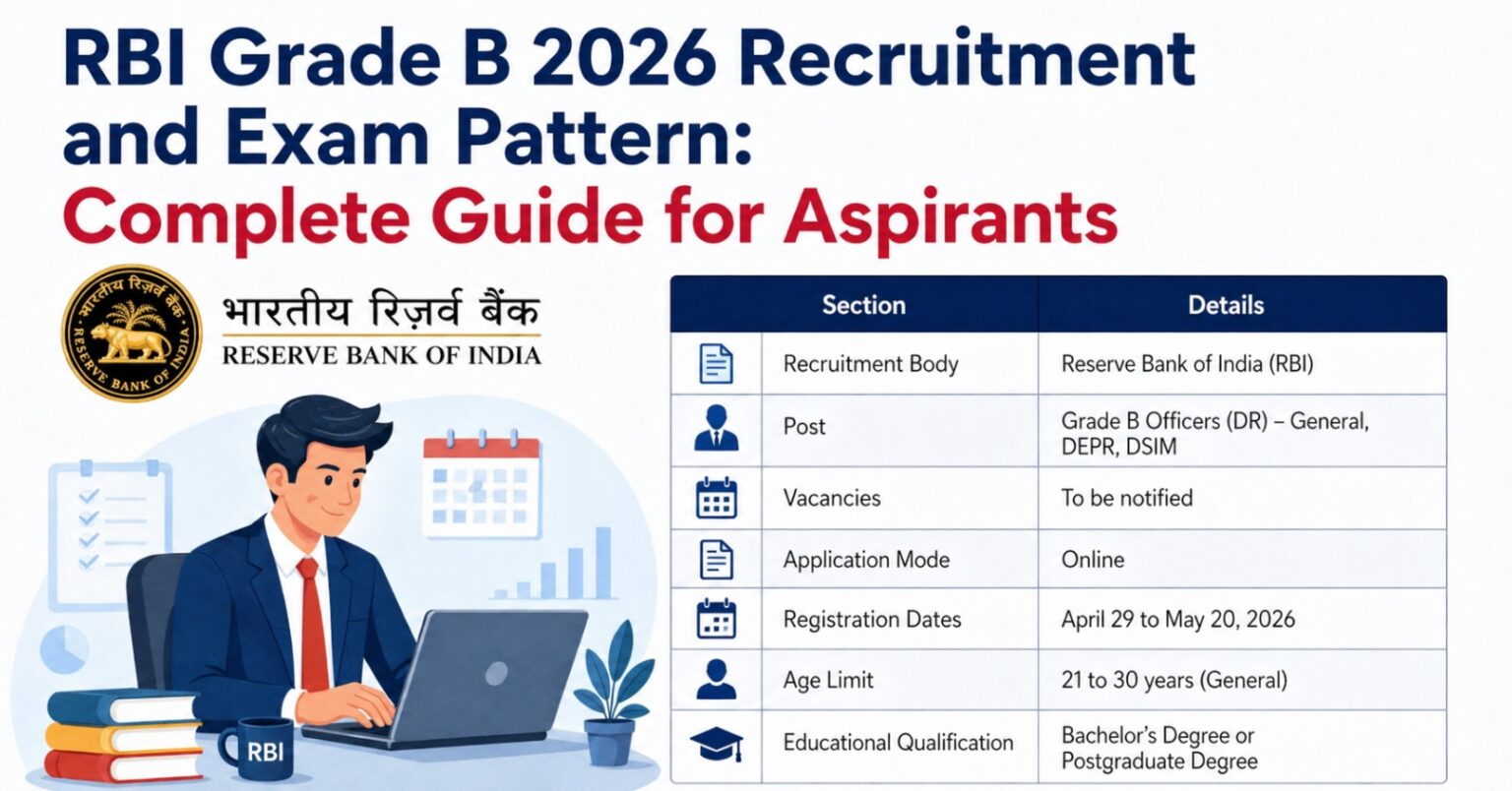
The RBI Grade B exam is one of the most respected competitive exams for candidates who want to build a career in the banking and financial sector. Every year, thousands of aspirants prepare for this opportunity because it offers career growth, job security, and a prestigious professional role. If you are planning to appear in the 2026 recruitment cycle, understanding the selection process and exam pattern is the first step toward smart preparation.
The RBI Grade B Exam is conducted for multiple streams, including General, DEPR, and DSIM, though the General stream receives the highest number of applications. The recruitment process generally includes Phase 1, Phase 2, and Interview stages. Understanding these stages helps candidates prepare with better focus. At Chanakya’s Coaching Centre, many aspirants begin by learning the exam structure first, which often creates a stronger foundation for preparation.
Recruitment Notification and Application Process
The official notification for 2026 includes important details related to vacancies, eligibility, application dates, and exam schedules. As per the notification, the online application process is scheduled to begin on April 29, 2026, and candidates can submit applications until May 20, 2026 (6:00 PM). During this period, aspirants must complete registration, upload required documents, and pay the application fee through the official process.
Candidates should avoid waiting until the last date to apply. Early registration reduces stress and allows more time to focus on preparation. It also gives candidates time to correct any errors in the application form if needed. Understanding the recruitment timeline is important because every stage follows a strict schedule, and missing deadlines can affect your chance to appear in the examination.
According to the schedule, the Phase 1 examination for General posts is set for June 13, 2026, while the Phase 1 exam for DEPR and DSIM is scheduled for June 14, 2026. Candidates qualifying in the first stage will move to the next level, where the Phase 2 examination for General posts is scheduled for July 25, 2026, followed by the Phase 2 examination for DEPR and DSIM on July 26, 2026.
With the notification and exam dates already outlined, aspirants should align their preparation plan with this timeline. Creating a study strategy around these dates can help improve revision, mock test planning, and overall exam readiness.
Eligibility Criteria for Aspirants
Before applying, candidates should understand the eligibility criteria. This generally includes educational qualifications, age limits, and category-based relaxation. For the General stream, candidates usually need a bachelor’s degree with the required marks, while specialized streams may need advanced qualifications related to economics or statistics.
Age limits are generally set within a fixed range, with relaxations available for eligible categories according to government rules. Many aspirants ignore eligibility details in the early stage of preparation. However, checking eligibility first can prevent confusion later. It also ensures that preparation is aligned with the right exam stream. Candidates should also verify whether any work experience or subject-specific requirements apply before submitting the application.
Exam Pattern for Phase 1
The preliminary stage serves as the first screening round. It is objective in nature and usually includes General Awareness, Reasoning Ability, English Language, and Quantitative Aptitude. General Awareness often plays a major role in scoring because it includes banking awareness, current affairs, economic updates, and financial news.
Reasoning tests logic, analytical thinking, and problem-solving ability. Quantitative Aptitude checks speed and accuracy in numerical questions, while English evaluates reading and comprehension skills. Success in this stage depends on balancing speed with accuracy. Since competition is high, candidates should prepare for sectional performance as well as the overall score.
Mock tests play an important role in preparation because they help improve time management and reduce mistakes under exam conditions. Regular revision is also essential. Without revision, even well-prepared topics may become weak over time.
Phase 2 Exam Pattern and Subject Structure
Phase 2 is often considered the most important stage because it carries significant weight in final selection. It generally includes Economic and Social Issues, Finance and Management, and English Descriptive papers. Economic and Social Issues covers topics such as inflation, growth, poverty, development, and economic reforms.
Finance and Management focuses on financial systems, governance, management principles, and risk concepts. The descriptive paper evaluates writing ability, clarity, and structured thought. This stage requires deeper understanding than objective preparation, so candidates need strong concepts rather than only memorization.
Answer-writing practice becomes important here. Many aspirants study theory but do not practice writing answers, which often affects performance. A better approach is to combine concept study with regular writing practice. This improves structure, speed, and confidence. Candidates should also link current affairs with static concepts so their answers become stronger and more relevant.
Interview and Final Selection Process
After clearing the written stages, candidates move to the interview round. This stage evaluates communication, personality, awareness, and decision-making ability. Questions may be based on academics, current affairs, financial developments, and career motivation.
The interview is not only about technical knowledge. It also tests clarity, confidence, and presence of mind. Candidates should prepare mock interviews and revise profile-based questions. They should remain updated on economic developments because awareness often plays an important role.
Many candidates underestimate this stage. However, interview performance can influence final selection. Good preparation often includes practicing responses, improving communication, and staying calm under pressure. At Chanakya’s Coaching Centre, interview preparation is treated as a serious part of the selection process rather than something to begin at the last moment.
Roles and Career Growth Opportunities
Understanding the RBI Grade B Post helps aspirants stay motivated. The role often includes responsibilities related to financial regulation, policy implementation, banking supervision, and economic analysis. Officers may contribute to research, compliance monitoring, and regulatory functions.
This level of responsibility is one reason the post is highly respected. Career growth is another major advantage. Officers may move into senior positions through promotions and experience. Many aspirants choose this career not only for salary but also for the opportunity to work in India’s financial system.
The role offers both stability and professional development, which makes it attractive for long-term career planning.
Preparation Strategy for Beginners
A structured preparation plan is essential for clearing RBI Grade B. Beginners should first understand the syllabus and exam pattern. After that, they should select limited but reliable resources. Using too many books often creates confusion, while a focused set of sources usually works better.
Preparation should include objective practice, descriptive writing, mock tests, and current affairs revision. Daily study habits matter. Even small, consistent efforts often produce stronger results than irregular hard work. Candidates should divide their time across subjects instead of focusing only on favorite topics.
Weak areas should be identified early and improved gradually. Monthly progress reviews can help track preparation. Transition words such as however, therefore, and moreover can also improve writing quality in descriptive papers.
Common Mistakes During Preparation
Many candidates make avoidable mistakes. One common mistake is preparing only for Phase 1 while ignoring the second stage. Another mistake is neglecting mock tests. Without test practice, time pressure often becomes difficult in the real exam.
Some aspirants also ignore descriptive writing, which can create problems in the mains stage. Another mistake is using too many resources. Too much material often leads to repetition without mastery. Some candidates also focus only on current affairs and ignore concept-building, which weakens performance in analytical questions.
A balanced approach works better. Preparing all stages together, building concepts, revising regularly, and practicing under exam conditions often produces stronger outcomes.
Why Does It Remain a Top Career Choice?
The popularity of RBI Grade B continues to grow because it offers prestige, stability, and meaningful work. Unlike many other exams, it provides exposure to policy-level functions and financial systems. This attracts aspirants who want a career beyond routine administration.
It also offers long-term growth. Promotions, learning opportunities, and specialized responsibilities make it a strong professional path. Candidates interested in economics, finance, regulation, and governance often find this opportunity especially valuable.
The exam is competitive, but it is manageable with proper planning. Many successful candidates begin by understanding the structure and then build preparation step by step. That disciplined approach often leads to better performance.
Importance of Revision and Mock Practice
Revision is often the difference between average and strong preparation. Many candidates study new topics but fail to revise old ones, which reduces retention. A good preparation plan includes regular revision cycles.
Daily revision can strengthen recently learned topics. Weekly revision can improve retention. Monthly revision can help consolidate the full syllabus. Mock practice is equally important because mock tests reveal mistakes, weak areas, and time management issues.
They also help build exam confidence. Candidates should analyze every mock instead of only checking scores. Improvement often comes from reviewing mistakes. That is where learning happens.
How to Build a Smart Study Plan?
A study plan should be practical and realistic. It should match the candidate’s available time and preparation level. A beginner may start with concept-building, while an advanced candidate may focus more on mocks and revision.
Study plans should include short-term and long-term goals. Daily goals keep preparation active. Weekly goals create discipline. Monthly goals help track progress. Candidates should also keep room for flexibility so the plan can adjust if one area needs extra work.
A rigid plan often breaks, while a practical plan often works. Consistency matters more than perfection.
Conclusion
Preparing for RBI Grade B 2026 requires a clear understanding of the recruitment process, exam structure, and preparation strategy. Every stage, from Phase 1 and Phase 2 to the interview, plays a role in final success.
The process is competitive, but it is manageable with focused effort. Regular practice, concept clarity, mock tests, and revision can make a major difference. Candidates who begin early often gain an advantage.
With the right approach, disciplined preparation, and proper guidance, aspirants can improve their chances of success and move closer to securing this prestigious opportunity.
Frequently Asked Questions
1. What is the selection process for RBI Grade B 2026?
The RBI Grade B selection process generally includes three stages: Phase 1 preliminary exam, Phase 2 mains exam, and the interview round. Candidates must clear each stage to move forward in the recruitment process and secure the RBI Grade B Post.
2. What is the exam pattern of the RBI Grade B Exam?
The RBI Grade B Exam usually consists of Phase 1 with objective questions on General Awareness, Reasoning, English, and Quantitative Aptitude. Phase 2 includes Economic and Social Issues, Finance and Management, and English Descriptive papers, followed by an interview.
3. What is the eligibility for RBI Grade B 2026 recruitment?
Eligibility for RBI Grade B generally includes a bachelor’s degree with required marks, age criteria, and category-based relaxations. Candidates should check the official notification for exact educational and age requirements before applying.
4. Is the RBI Grade B Post a good career option?
Yes, the RBI Grade B Post is considered a highly respected career option because it offers job security, strong salary benefits, career growth, and opportunities to work in financial regulation and policy-related roles.
5. How should beginners prepare for the RBI Grade B Exam?
Beginners should start by understanding the RBI Grade B Exam pattern, creating a study plan, practicing mock tests, improving current affairs preparation, and working on descriptive answer writing for Phase 2. Consistent revision is also important for success.