
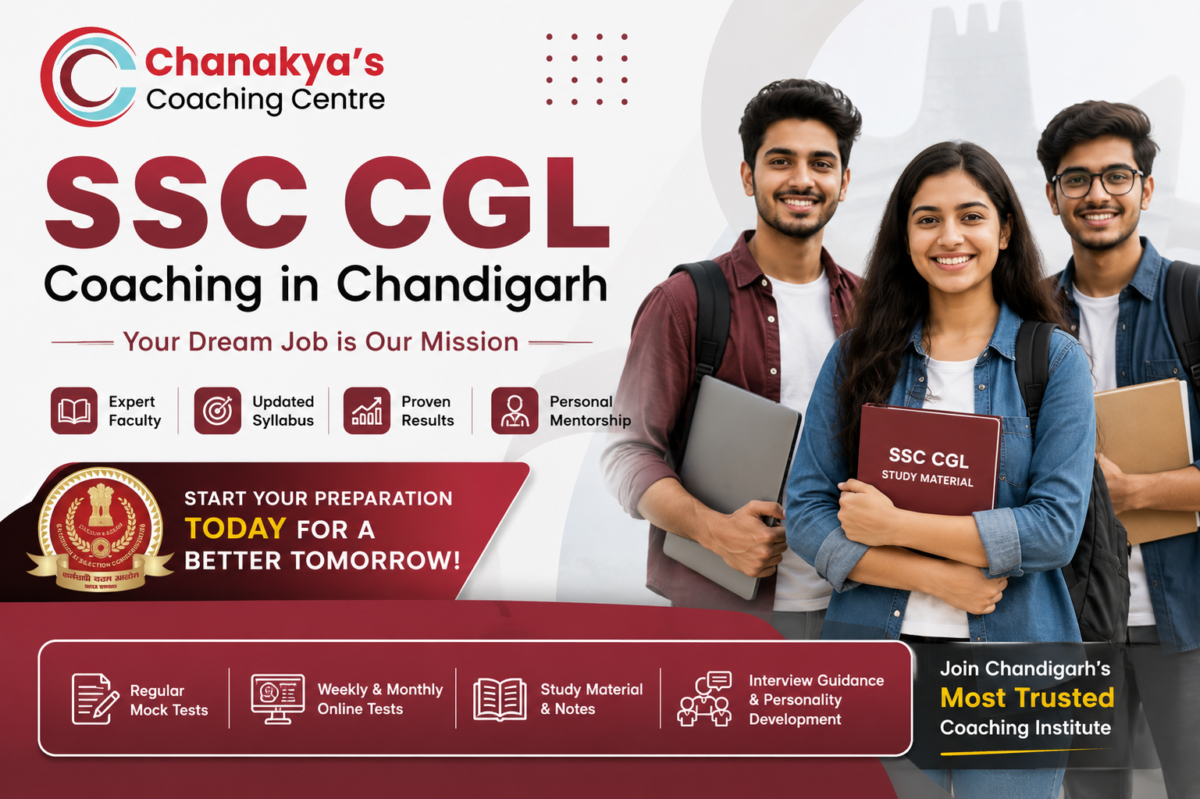
SSC CGL Coaching In Chandigarh helps graduates prepare systematically for one of India’s most competitive government recruitment examinations. At Chanakya’s Coaching Centre, students can build subject knowledge, improve calculation speed, practise previous-year questions and prepare for Tier I and Tier II through an organised study plan. The programme focuses on concept clarity, regular revision, time management, mock-test analysis and examination-oriented practice.
The SSC Combined Graduate Level Examination opens opportunities for various Group B and Group C posts in ministries, government departments and associated organisations. However, the extensive syllabus and strong competition make unplanned preparation difficult. Candidates need a practical strategy that covers every subject while leaving enough time for revision and mock examinations.
What Is the SSC CGL Examination?
SSC CGL stands for Staff Selection Commission Combined Graduate Level Examination. The Staff Selection Commission conducts this examination to recruit graduates for different central government posts.
Depending on the vacancies listed in the official notification, candidates may apply for posts such as:
- Assistant Section Officer
- Income Tax Inspector
- Inspector in central government departments
- Assistant Enforcement Officer
- Auditor
- Accountant
- Junior Accountant
- Divisional Accountant
- Tax Assistant
- Postal Assistant
- Sorting Assistant
- Junior Statistical Officer
- Statistical Investigator Grade II
- Upper Division Clerk
- Other Group B and Group C positions
Every post may have different age limits, educational requirements, physical standards or skill requirements. Therefore, candidates should read the official post-wise eligibility conditions before submitting their preferences.
Why Choose SSC CGL Coaching In Chandigarh?
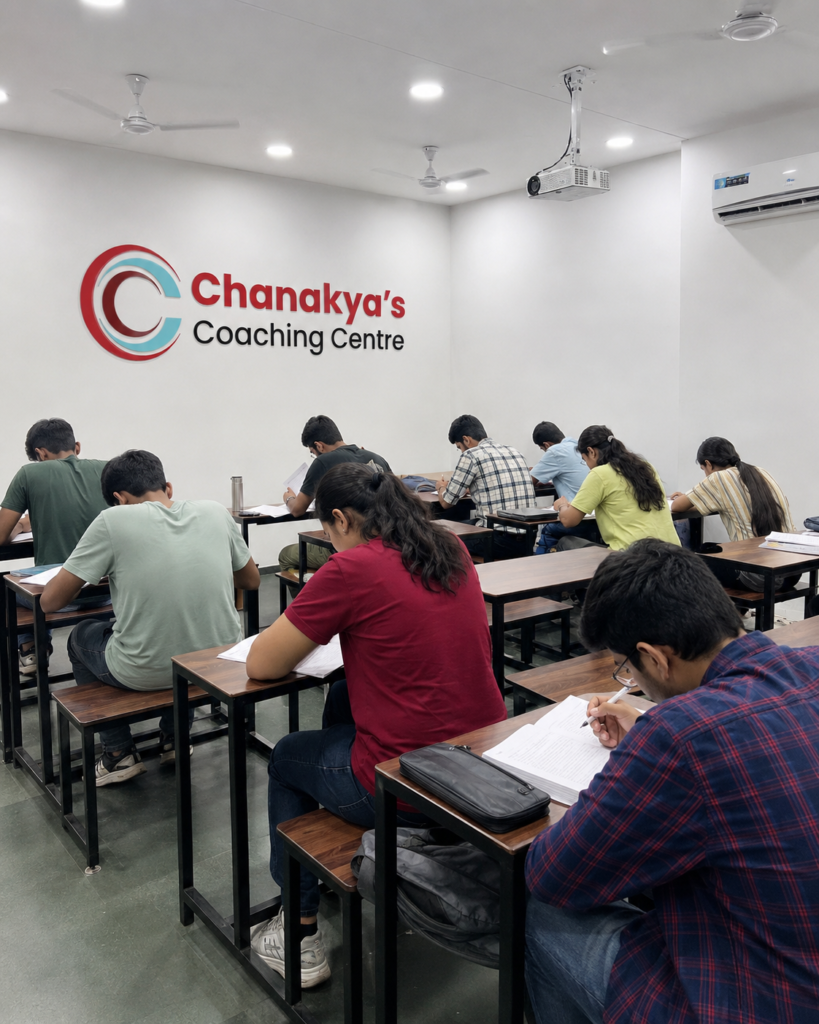
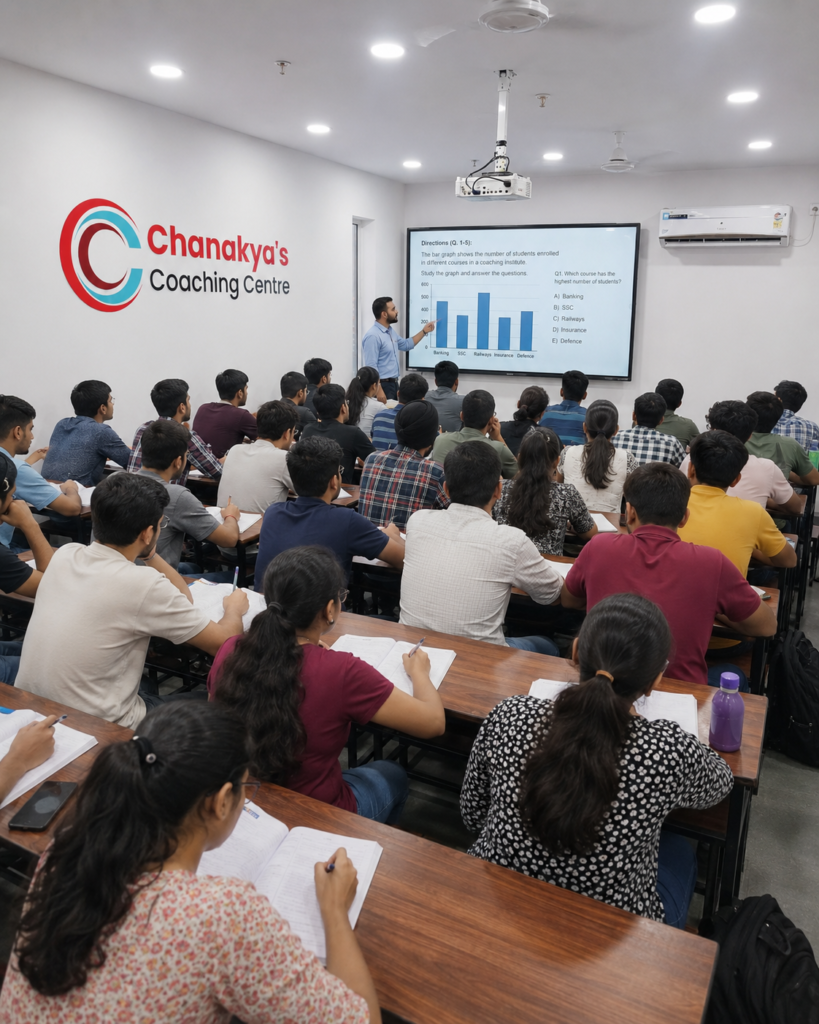
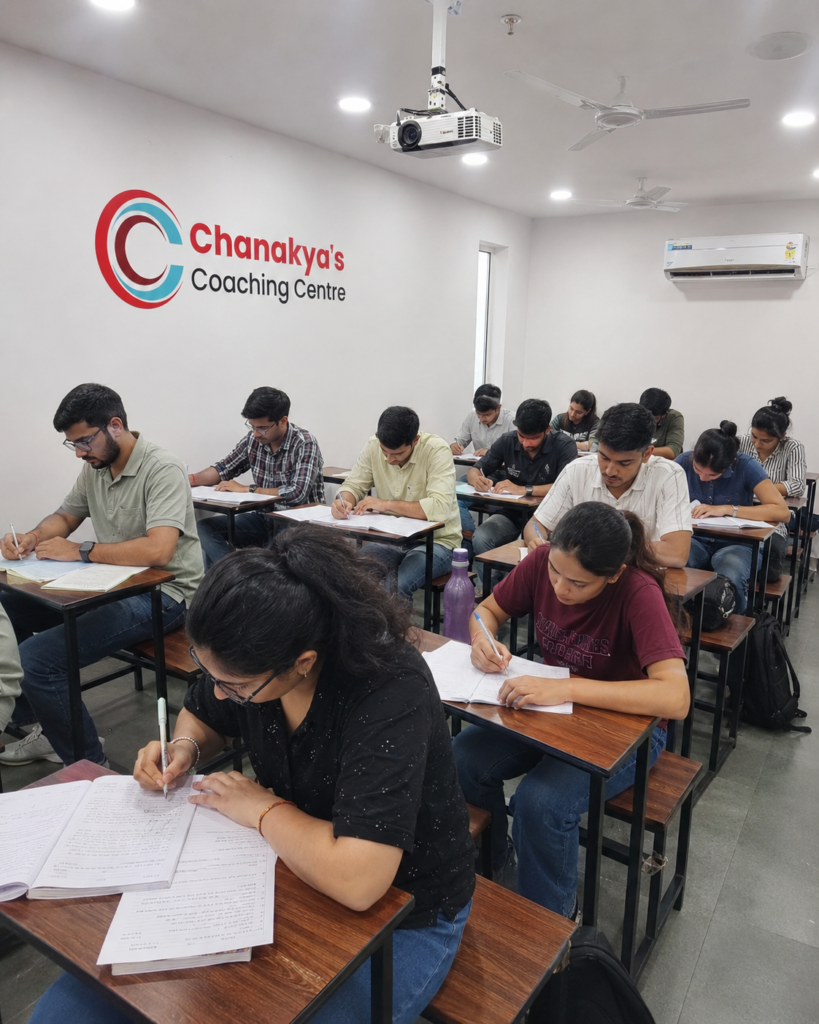
Joining a structured programme can help candidates avoid random preparation. It provides a defined sequence for completing topics, solving questions, revising concepts and evaluating performance.
A classroom-based preparation system can help students:
- Understand difficult concepts through detailed explanations.
- Cover Tier I and Tier II topics in a planned sequence.
- Improve speed through timed exercises.
- Learn reliable calculation methods.
- Practise chapter-wise and mixed questions.
- Solve previous-year SSC papers.
- Identify weak topics through tests.
- Build examination confidence.
- Maintain consistency throughout preparation.
- Receive guidance for revision and mock analysis.
Chandigarh is also a convenient education centre for aspirants from Punjab, Haryana, Himachal Pradesh and nearby regions. Students can access a competitive learning environment and follow a regular study routine.
Latest SSC CGL 2026 Notification Update
The Staff Selection Commission published the Combined Graduate Level Examination 2026 notification on 21 May 2026. The original online application window remained open from 21 May to 22 June 2026.
SSC later reopened the application window from 23 June 2026 at 11:00 PM to 25 June 2026 at 11:00 PM. The revised deadline for online fee payment was 26 June 2026. The application correction window was available from 1 July to 3 July 2026. According to the reopening notice, more than 28 lakh applicants had submitted their forms during the original application period.
Important SSC CGL 2026 Dates
| Event | Date |
|---|---|
| Notification release | 21 May 2026 |
| Original application period | 21 May–22 June 2026 |
| Reopened application window | 23–25 June 2026 |
| Revised fee payment deadline | 26 June 2026 |
| Application correction window | 1–3 July 2026 |
| Tier I examination | Check the latest official SSC update |
| Tier II examination | To be announced by SSC |
Candidates should regularly check the official SSC website for examination dates, application status, city information, admission certificates, answer keys and results. The Commission may revise tentative dates through separate notices.
SSC CGL Eligibility Criteria
Eligibility conditions may differ according to the post. Candidates should check their educational qualification, age, nationality and category before applying.
Educational Qualification
For most SSC CGL posts, an applicant must hold a bachelor’s degree from a recognised university or equivalent institution.
Certain specialised posts have additional academic requirements. For example, statistical posts may require Mathematics at the Class 12 level or Statistics as a subject during graduation.
Candidates appearing in the final year of graduation must satisfy the qualification requirement by the crucial date stated in the official notification.
Age Limit
The SSC CGL age limit is not the same for every post. Common post-wise age ranges may include:
- 18 to 27 years
- 18 to 30 years
- 18 to 32 years
- 20 to 30 years
Upper-age relaxation is available to eligible reserved categories according to applicable government rules. Candidates must verify the post-wise age requirement and date-of-birth conditions in the latest notice.
Nationality
Applicants must satisfy the nationality or citizenship conditions prescribed by the Staff Selection Commission.
SSC CGL Selection Process
The current SSC CGL examination structure consists of two computer-based tiers:
- Tier I Computer-Based Examination
- Tier II Computer-Based Examination
Tier I is used to shortlist candidates for Tier II. Final selection is based on the applicable Tier II papers, qualifying modules, post preferences, eligibility verification and other conditions prescribed by SSC.
Candidates should prepare for both tiers together because several topics overlap. Waiting until the Tier I result to begin Tier II preparation can reduce the time available for advanced practice.
SSC CGL Tier I Exam Pattern
Tier I consists of 100 objective questions carrying 200 marks. Candidates receive 60 minutes to complete the examination.
| Subject | Questions | Maximum Marks |
| General Intelligence and Reasoning | 25 | 50 |
| General Awareness | 25 | 50 |
| Quantitative Aptitude | 25 | 50 |
| English Comprehension | 25 | 50 |
| Total | 100 | 200 |
A negative marking of 0.50 marks applies to each incorrect answer. The questions are available in Hindi and English, except for the English Comprehension section.
The Tier I paper tests speed, accuracy and question selection. Candidates have approximately 36 seconds per question if the available time is divided equally. Therefore, learning when to attempt, skip or revisit a question is essential.
SSC CGL Tier II Exam Pattern
Tier II Paper I is compulsory for all shortlisted candidates. It includes three sections and multiple modules.
Section I
Module I: Mathematical Abilities
- 30 questions
- 90 marks
Module II: Reasoning and General Intelligence
- 30 questions
- 90 marks
Section II
Module I: English Language and Comprehension
- 45 questions
- 135 marks
Module II: General Awareness
- 25 questions
- 75 marks
Section III
Module I: Computer Knowledge Test
- 20 questions
- 60 marks
Module II: Data Entry Speed Test
- One data-entry task
Paper I is conducted through two sessions. Candidates must qualify in every applicable section. The Computer Knowledge Test and Data Entry Speed Test are mandatory, although they are generally qualifying in nature. Higher qualifying standards may apply to specific posts.
Paper II in Statistics is conducted only for candidates shortlisted for relevant statistical posts, such as Junior Statistical Officer and Statistical Investigator Grade II.
Negative Marking in Tier II
Tier II requires careful question selection because the negative marking is higher than Tier I.
- One mark may be deducted for each incorrect answer in Sections I and II and the Computer Knowledge module of Paper I.
- A penalty of 0.50 marks may apply to each incorrect answer in Paper II.
Candidates should avoid unnecessary guesswork and focus on accurate attempts.
Complete Syllabus Covered in SSC CGL Coaching In Chandigarh
The syllabus is divided into Mathematics, Reasoning, English, General Awareness, Computer Knowledge and Data Entry Skills. A successful candidate must understand the concepts and apply them within strict time limits.
General Intelligence and Reasoning Syllabus
Reasoning tests logical thinking, observation, pattern recognition and decision-making ability.
Important topics include:
- Semantic analogy
- Number analogy
- Figural analogy
- Classification
- Number series
- Alphabet series
- Figural series
- Coding and decoding
- Syllogism
- Statement and conclusion
- Venn diagrams
- Blood relations
- Direction and distance
- Ranking and order
- Mathematical operations
- Word formation
- Space orientation
- Space visualisation
- Embedded figures
- Mirror images
- Water images
- Paper folding and unfolding
- Figure completion
- Critical thinking
- Problem-solving
- Social intelligence
- Emotional intelligence
Students should avoid memorising answers. They should understand the logic behind each question type and practise variations of the same concept.
Quantitative Aptitude and Mathematical Abilities Syllabus
Mathematics is a scoring section when concepts and calculations are strong. However, weak fundamentals can make this section time-consuming.
The syllabus includes:
Arithmetic
- Number system
- Decimals and fractions
- Simplification
- Percentage
- Ratio and proportion
- Average
- Profit and loss
- Discount
- Simple interest
- Compound interest
- Partnership
- Mixture and alligation
- Time and work
- Pipes and cisterns
- Time, speed and distance
- Boats and streams
Advanced Mathematics
- Algebraic identities
- Linear equations
- Elementary surds
- Geometry
- Triangles
- Circles
- Quadrilaterals
- Polygons
- Congruence and similarity
- Mensuration
- Trigonometric ratios
- Heights and distances
- Coordinate-based concepts
Data and Statistics
- Tables and graphs
- Bar diagrams
- Pie charts
- Histograms
- Frequency polygons
- Mean
- Median
- Mode
- Standard deviation
- Basic probability
Students should first master standard methods. Shortcuts should be used only after the concepts are clear. Formula revision, mental calculations and timed practice are necessary for improving speed.
English Language and Comprehension Syllabus
The English section evaluates grammar, vocabulary, sentence structure and comprehension ability.
Important topics include:
- Spotting errors
- Sentence improvement
- Fill in the blanks
- Synonyms
- Antonyms
- Homonyms
- Spellings
- One-word substitution
- Idioms and phrases
- Active and passive voice
- Direct and indirect narration
- Sentence rearrangement
- Para jumbles
- Cloze test
- Reading comprehension
- Vocabulary usage
- Grammar rules
- Sentence structure
Tier II English requires deeper preparation because it carries a significant number of questions. Candidates should develop daily reading habits and maintain a vocabulary notebook.
General Awareness Syllabus
General Awareness combines current affairs with static knowledge.
The syllabus includes:
- Indian history
- Indian geography
- World geography
- Indian Constitution
- Indian polity
- Economics
- General science
- Physics
- Chemistry
- Biology
- Scientific research
- Art and culture
- Important government schemes
- National and international organisations
- Awards and honours
- Books and authors
- Sports
- Important days
- Current national events
- Current international events
- Environmental issues
- Neighbouring countries of India
Candidates should revise General Awareness regularly. Reading information once is not enough because facts can be forgotten quickly. Weekly quizzes, monthly revision and previous-year questions improve retention.
Computer Knowledge Syllabus
The Computer Knowledge Test covers basic computer use and digital awareness.
Important topics include:
- Organisation of a computer
- Central Processing Unit
- Input and output devices
- Computer memory
- Storage devices
- Backup devices
- Computer ports
- Keyboard shortcuts
- Windows operating system
- Windows Explorer
- Microsoft Word
- Microsoft Excel
- Microsoft PowerPoint
- Internet browsing
- Search engines
- Uploading and downloading
- Email account management
- Electronic banking
- Networking devices
- Networking protocols
- Cybersecurity
- Viruses and worms
- Trojan attacks
- Hacking
- Preventive security measures
The official syllabus includes computer fundamentals, Microsoft Office, internet use, networking and basic cybersecurity.
Data Entry Speed Test
The Data Entry Speed Test evaluates typing speed and accuracy. It generally involves approximately 2,000 key depressions within 15 minutes.
The test is mandatory for applicable candidates and is usually qualifying in nature. Candidates should begin typing practice early instead of waiting until the Tier II examination approaches.
Statistics Paper Syllabus
Candidates applying for statistical posts may need to prepare for Paper II. Major topics include:
- Collection and presentation of data
- Primary and secondary data
- Frequency distribution
- Measures of central tendency
- Measures of dispersion
- Moments
- Skewness and kurtosis
- Correlation and regression
- Probability theory
- Random variables
- Probability distributions
- Sampling theory
- Statistical inference
- Analysis of variance
- Time-series analysis
- Index numbers
Teaching Methodology at Chanakya’s Coaching Centre
Chanakya’s Coaching Centre follows a preparation approach that combines concept learning, practice, revision and performance analysis.
Concept-Based Classroom Learning
Every topic should begin with fundamental concepts. This approach helps students understand why a method works and how it can be applied to different questions.
Chapter-Wise Practice
After completing a topic, students should solve questions arranged by concept and difficulty level. This method strengthens understanding before mixed practice begins.
Previous-Year Question Practice
Previous-year SSC questions reveal recurring concepts, common question formats and expected difficulty levels. They also help students understand how the Commission frames questions.
Regular Sectional Tests
Sectional tests allow candidates to focus on one subject at a time. They help identify whether a student needs improvement in knowledge, calculation speed or question selection.
Full-Length Mock Examinations
Full mock tests create a real examination environment. They teach candidates how to manage all four Tier I sections within 60 minutes.
Doubt Resolution and Revision
Unresolved doubts can create difficulty in advanced topics. Regular doubt clarification and planned revision help prevent learning gaps.
How SSC CGL Coaching In Chandigarh Improves Exam Readiness
A structured course does more than explain the syllabus. It helps students convert knowledge into examination performance.
Personalised Weak-Area Identification
Every student has different strengths. One candidate may perform well in Reasoning but struggle with Mathematics. Another may have good calculation speed but weak English grammar.
Regular testing helps identify these differences so students can adjust their study time.
Better Time Management
Candidates must learn how much time to spend on each section. They should also know when to leave a lengthy question.
Time management improves through:
- Timed topic tests
- Sectional examinations
- Full-length mock tests
- Question-selection exercises
- Speed calculation practice
Improved Accuracy
Attempting more questions is useful only when accuracy remains high. Negative marking can reduce the benefit of extra attempts.
Candidates should focus on:
- Reading questions carefully.
- Avoiding unverified assumptions.
- Checking calculation signs.
- Eliminating incorrect options.
- Reducing blind guesses.
- Reviewing repeated mistakes.
A Practical SSC CGL Study Plan
Phase One: Foundation Building
During the first phase, students should focus on basic arithmetic, grammar rules, reasoning concepts and static General Awareness.
The aim is to build clarity rather than speed.
Phase Two: Topic-Wise Practice
After learning the fundamentals, candidates should solve easy, moderate and advanced questions from each chapter.
A topic should not be considered complete until the student can solve its common question patterns independently.
Phase Three: Previous-Year Papers
Candidates should solve previous-year questions in a timed format. They should also group repeated questions according to topics.
This process helps identify high-frequency concepts.
Phase Four: Sectional Testing
Separate subject tests can reveal which section is reducing the overall score. Students can then revise specific chapters instead of repeating the entire syllabus.
Phase Five: Full Mock Examinations
Full mock tests should begin after a reasonable portion of the syllabus has been completed. Candidates should gradually increase their testing frequency.
Phase Six: Final Revision
The final phase should focus on:
- Formula revision
- Vocabulary revision
- Current-affairs notes
- Frequently repeated facts
- Error-notebook revision
- Previous mock mistakes
- Important computer concepts
- Typing practice
How to Analyse a Mock Test Properly
A mock examination is useful only when the student analyses it.
After each test, divide mistakes into four groups:
- Conceptual errors
- Calculation errors
- Time-management errors
- Guesswork-related errors
Candidates should also review correct answers that took too long. A correct answer completed in three or four minutes may still create a time-management problem.
Maintain an error notebook containing:
- Questions answered incorrectly
- Formulas frequently forgotten
- Confusing grammar rules
- New vocabulary
- Important General Awareness facts
- Short calculation methods
- Repeated reasoning patterns
Review this notebook every week.
Common Preparation Mistakes to Avoid
Candidates often lose marks because of an unbalanced strategy.
Avoid these common mistakes:
- Beginning preparation without understanding the syllabus.
- Ignoring Tier II until Tier I is completed.
- Using too many books and online sources.
- Learning shortcuts without understanding concepts.
- Avoiding difficult Mathematics chapters.
- Reading current affairs without revision.
- Taking mocks without analysing mistakes.
- Guessing answers despite negative marking.
- Ignoring Computer Knowledge.
- Delaying typing practice.
- Changing the study plan frequently.
- Studying for long hours without measurable targets.
Consistency and analysis are more useful than collecting unnecessary material.
Preparation Strategy for College Students
College students should begin with two to three focused study hours on regular days. They can increase the duration during weekends and holidays.
A practical schedule may include:
- Mathematics practice in the morning.
- English or Reasoning after college.
- General Awareness revision before sleeping.
- One sectional test during the weekend.
- One previous-year paper every week.
Beginning early gives students enough time to improve weak subjects without pressure.
Preparation Strategy for Working Candidates
Working aspirants should focus on regularity instead of unrealistic daily targets.
They can:
- Study one subject before work.
- Revise General Awareness during breaks.
- Practise English vocabulary while travelling.
- Solve questions after work.
- Attempt longer mock tests on weekends.
- Use weekly targets instead of daily pressure.
A focused two-hour routine can be more productive than irregular six-hour study sessions.
Who Should Join the Course?
The programme is suitable for:
- First-time SSC CGL aspirants
- College students planning early preparation
- Working professionals
- Repeat candidates
- Aspirants with weak Mathematics fundamentals
- Students requiring regular tests
- Candidates preparing for multiple SSC examinations
- Students who need a disciplined study timetable
Frequently Asked Questions
Which is the best SSC CGL institute in Chandigarh?
The right institute should provide complete Tier I and Tier II syllabus coverage, knowledgeable faculty, updated material, regular tests, previous-year questions and doubt support. Candidates should compare the teaching approach and attend a counselling session before enrolling.
What is the fee for SSC CGL coaching in Chandigarh?
Fees may differ according to the course duration, batch type, study material and facilities included. Students should contact the institute for the current fee structure and available payment options.
How long does SSC CGL preparation take?
Most candidates need several months of systematic preparation. The required duration depends on subject knowledge, daily study time, academic background and previous examination experience.
Can a beginner clear SSC CGL?
Yes. Beginners can prepare effectively when they begin with fundamental concepts and follow a consistent practice schedule. They should avoid jumping directly to advanced mock tests.
Is SSC CGL difficult to clear?
The syllabus is manageable, but the competition and time pressure make the examination challenging. Consistent preparation, strong accuracy and mock-test analysis can improve performance.
Is Mathematics compulsory in SSC CGL?
Yes. Quantitative Aptitude appears in Tier I, while Mathematical Abilities is included in compulsory Tier II Paper I.
Can I prepare for SSC CGL without coaching?
Self-study is possible with a clear strategy and reliable resources. However, coaching may help students who need structure, doubt clarification, regular evaluation and guidance.
Should Tier I and Tier II be prepared together?
Yes. Integrated preparation is recommended because several topics overlap. Tier II should not be postponed until after the Tier I result.
How many hours should I study daily?
A beginner may start with three to four focused hours. Working candidates can begin with two regular hours. Study quality, revision and test analysis matter more than sitting for long periods.
How many mock tests should I attempt?
There is no fixed number. Begin with chapter-wise and sectional tests. Later, take full mock examinations regularly. Each mock should be analysed before attempting the next one.
Does SSC CGL have negative marking?
Yes. Tier I has a penalty of 0.50 marks for each incorrect answer. Tier II also includes negative marking according to the applicable section and paper.
Is the Data Entry Speed Test mandatory?
The test is mandatory for applicable candidates and is generally qualifying in nature. Candidates should still prepare seriously because failing a qualifying module can affect selection.
Can final-year graduation students apply?
They may apply only when they can satisfy the required educational qualification by the crucial date stated in the official notification.
How many attempts are allowed in SSC CGL?
SSC generally does not prescribe a fixed number of attempts. A candidate can apply while meeting the relevant age, qualification and eligibility conditions.
When will the SSC CGL 2026 examination be conducted?
Candidates should check the latest examination calendar and notices published by the Staff Selection Commission. Dates can be revised, so applicants should rely on the official SSC website.
Begin Your Preparation with a Clear Strategy
Success in SSC CGL requires more than completing books. Candidates must understand concepts, practise under time limits, analyse mistakes and revise regularly. A balanced preparation plan should give equal importance to Tier I, Tier II, Computer Knowledge and typing skills.
Students looking for SSC CGL coaching in Chandigarh can begin their preparation with Chanakya’s Coaching Centre. The course is designed to provide structured learning, topic-wise practice, previous-year question coverage, testing and revision support. Start early, remain consistent, and measure your progress through regular examinations.